

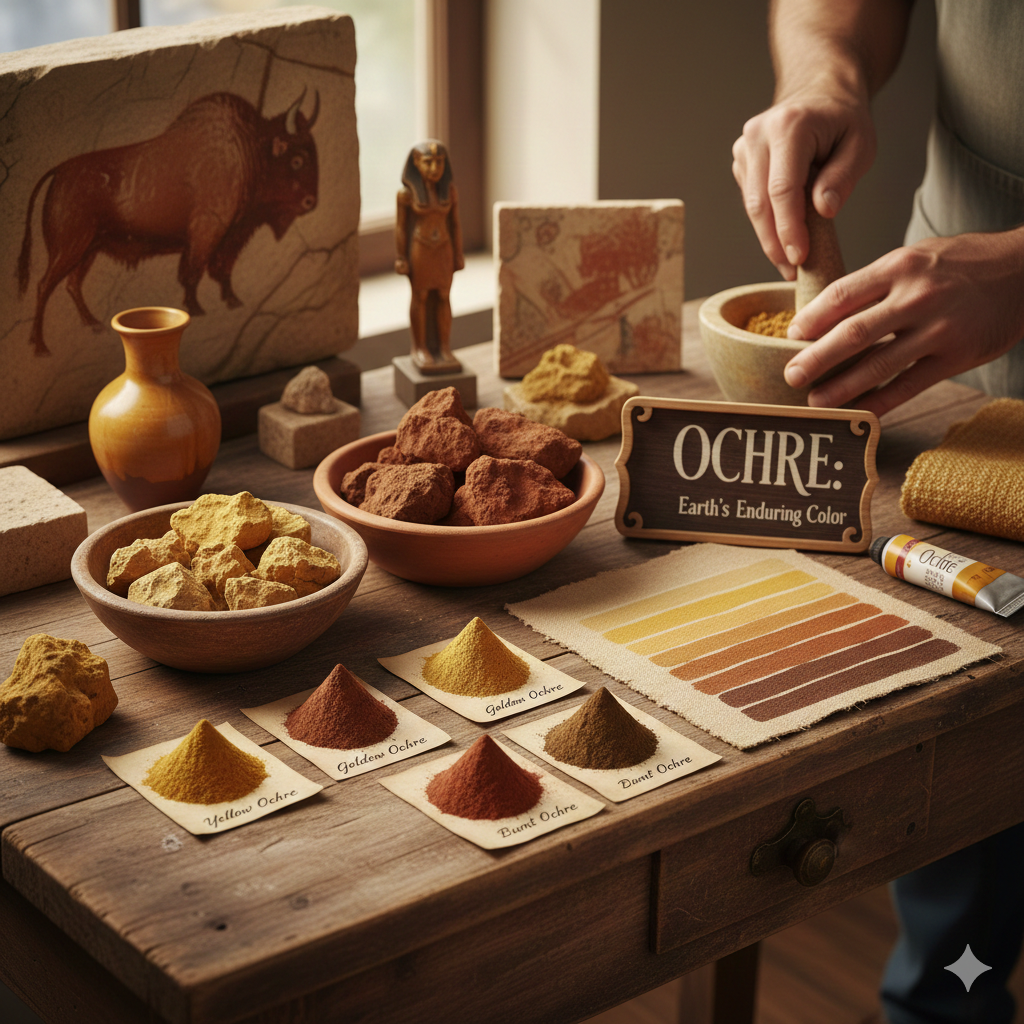
Introduction
Ochre is a naturally occurring earth pigment that contains iron oxide mixed with clay, sand, or silica. Because of this mineral composition, it produces warm, earthy colors that range from yellow to deep red and brown. Although it may appear simple, ochre is actually a complex material with many variations.
From a practical perspective, ochre is valued because it is abundant, easy to process, and extremely stable. As a result, it has been used continuously for tens of thousands of years. Moreover, unlike many synthetic pigments, ochre does not fade easily, which explains why ancient artworks still retain their color today.
Importantly, it is not a single color or substance. Instead, it is a category of pigments whose appearance depends on mineral content, moisture, and heat exposure. Therefore, understanding ochre requires looking at both its physical properties and its cultural role.
Ochre Meaning Explained
Definition of Ochre
The term “ochre” refers to both a natural pigment and the color derived from it. On one hand, it describes iron-rich earth materials used as pigments. On the other hand, it refers to warm yellow-brown or reddish tones inspired by those materials.
Historically, the word has been used to describe pigments that come directly from the ground. Consequently, it has always been associated with the earth, nature, and permanence.
Symbolic Meaning of Ochre
Beyond its physical definition, it carries strong symbolic meaning. Across cultures, it has been linked to life, blood, soil, and the sun. For this reason, it often appears in rituals, ceremonies, and sacred art.
Common symbolic associations include:
Connection to the earth
Stability and grounding
Warmth and protection
Tradition and ancestry
Spiritual power
In modern contexts, it still represents natural balance and authenticity. Therefore, it is frequently used in design to create warm and welcoming environments.
Understanding Ochre Color
What Color Is Ochre?
Its color is best described as a warm, earthy tone that sits between yellow and brown. However, depending on mineral composition, it can also lean toward red or orange. Unlike bright yellow, it is muted and soft. At the same time, it is lighter and warmer than most browns.
Common its color variations include:
Yellow ochre
Golden ochre
Red ochre
Burnt ochre
Dark brown ochre
Each variation has a slightly different visual impact. Nevertheless, all its colors share a natural, grounded appearance.
It Compared to Similar Colors
Although it is often confused with other earth tones, there are important differences.
In contrast to yellow, it is less vivid and more natural. Similarly, compared to brown, it is lighter and warmer. Meanwhile, rust tones are deeper and more orange-red, while beige lacks the strong pigment presence found in it.
Because of these distinctions, it is especially useful when designers want warmth without overwhelming brightness.
What Is Ochre Pigment?
Composition of its Pigment
Its pigment consists primarily of iron oxide combined with clay and other minerals. The iron oxide is responsible for the color, while the clay provides structure and binding properties.
There are two main forms of iron oxide involved:
Hydrated iron oxide, which produces yellow ochre
Anhydrous iron oxide, which produces red ochre
Therefore, changes in moisture or heat can significantly alter the pigment’s appearance.
How its Pigment Is Produced
The production of its pigment is remarkably simple. In fact, the basic process has remained almost unchanged for thousands of years.
Step-by-step process:
First, iron-rich earth is collected from natural deposits
Next, the material is crushed into smaller particles
Then, impurities are removed through washing and settling
After that, the pigment is dried thoroughly
Finally, it is ground into a fine powder
Additionally, heating yellow ochre transforms it into red ochre by removing water from the iron oxide. As a result, a wide range of colors can be produced from the same source material.
Types of Ochre
Main Types of its Explained
It is classified based on color, mineral composition, and processing method. While many variations exist, several main types are widely recognized.
Yellow Ochre
Yellow it is the most common and widely used form. Because it contains hydrated iron oxide, it has a soft, golden-yellow appearance.
Typical uses include:
Painting and illustration
Architectural finishes
Traditional crafts
Moreover, yellow it is popular because it mixes easily with other pigments.
Red Ochre
Red ochre forms either naturally or through heating yellow ochre. As the water content decreases, the color deepens into red and brown tones.
Common uses include:
Prehistoric cave paintings
Ceremonial body decoration
Murals and wall art
Because of its association with blood and life, red it often carries strong symbolic meaning.
Brown Ochre
Brown it contains additional minerals, such as manganese, which darken the pigment. Consequently, it produces richer, deeper tones.
It is often used in:
Landscape painting
Architectural coatings
Earth-tone palettes
Purple Ochre
Purple it is relatively rare. It forms under specific geological conditions and contains hematite with unique crystal structures.
Although less common, it is valued for:
Decorative artwork
Cultural artifacts
Natural dyes
Comparison Table: Types of Ochre
Type of its | Color Range | Main Mineral Content | Common Uses
Yellow Ochre | Yellow to golden | Hydrated iron oxide | Painting, walls, crafts
Red Ochre | Red to reddish-brown | Anhydrous iron oxide | Rituals, murals, art
Brown Ochre | Dark brown | Iron oxide with manganese | Architecture, design
Purple it | Muted purple | Hematite | Decorative arts
History of its
Prehistoric Use of Ochre
It is one of the earliest materials used by humans. Archaeological evidence shows its use dating back more than 100,000 years. During this time, early humans used it not only for decoration but also for symbolic expression.
For example, it was used in:
Cave paintings
Body painting
Tool marking
Burial rituals
As a result, it is often considered one of the first materials used for artistic and symbolic communication.
Ochre in Ancient Civilizations
Ancient Egypt
In ancient Egypt, it played an important role in art and symbolism. Red ochre represented vitality and power, while yellow it symbolized eternity. Consequently, both were widely used in tomb paintings and temple decorations.
Ancient Greece and Rome
Similarly, Greek and Roman artists used it pigments extensively in frescoes and architecture. Because it was durable and affordable, it was ideal for large public spaces.
Indigenous Cultures
Across the world, Indigenous cultures used it in ceremonies, storytelling, and identity marking. In many cases, it was considered sacred and deeply tied to ancestral land.
Medieval and Renaissance Periods
During the Middle Ages and Renaissance, it became a foundational pigment for painters. Moreover, it was compatible with different painting techniques, including fresco, tempera, and oil painting.
Artists valued it because it was reliable, versatile, and long-lasting. Therefore, it became a standard pigment in artist workshops.
Natural its Uses
Traditional Natural Uses
Beyond art, it served many practical purposes. For instance, it was used to protect skin from the sun and insects. Additionally, some cultures used it in medicinal practices.
Traditional uses include:
Skin protection
Insect repellent
Healing rituals
Material preservation
Thus, it was both functional and symbolic.
Ochre in Construction
Historically, it was used to color plasters, mortars, and building surfaces. As a result, many historic buildings still display warm ochre-toned walls.
Benefits include:
Natural weather resistance
Long-lasting color
Harmonious appearance
Modern Applications of Ochre
Ochre in Art
Today, it remains essential in fine art. Artists continue to use it because of its warmth, stability, and versatility.
It is commonly used in:
Oil painting
Watercolor
Acrylic painting
Drawing
Furthermore, it is often used as a base color for skin tones and landscapes.
Ochre in Interior Design
In modern interiors, it creates warmth and depth. Therefore, it is frequently used to balance minimalist or neutral spaces.
Popular applications include:
Accent walls
Textiles and upholstery
Ceramics and tiles
It pairs especially well with natural wood, stone, and neutral colors.
Ochre in Fashion
In fashion, it has gained popularity due to its earthy and timeless appeal. Moreover, it works well across seasons and skin tones.
Common uses include:
Clothing collections
Accessories
Natural fabric dyes
Industrial and Commercial Uses
It is also widely used in industrial applications. Because it is non-toxic and stable, it is suitable for consumer products.
Applications include:
Paints and coatings
Cosmetics
Concrete coloring
Ceramics
Why It Remains Important Today
It continues to be relevant because it aligns with modern values such as sustainability and authenticity. Additionally, its historical depth adds emotional and cultural value.
Key reasons include:
Natural origin
Environmental friendliness
Timeless aesthetic
Cultural significance
Consequently, it is experiencing renewed interest in contemporary design and art.
Frequently Asked Questions
What is ochre made of?
It is made from iron oxide mixed with clay and other natural minerals.
Is it a color or a pigment?
It is both a pigment and a color term describing earthy yellow, red, and brown tones.
What are the main types of it?
The main types are yellow ochre, red ochre, brown ochre, and purple ochre.
What are modern uses of its?
It is used in art, interior design, fashion, cosmetics, construction, and industrial products.
Is it natural?
Yes, it occurs naturally, although synthetic versions are also produced for consistency.
Why is ochre historically important?
It is important because it was one of the first materials used for art, symbolism, and practical purposes.
Conclusion
Ultimately, it is far more than a simple earth pigment. It represents humanity’s long-standing relationship with the natural world, creativity, and more expression. From prehistoric cave paintings to modern interiors, it has remained relevant because of its durability, beauty, and meaning.
As interest in natural materials continues to grow, it stands out as a timeless and sustainable choice. Whether used in art, design, or everyday products, it continues to connect the past, present, and future through color and culture.
