

Overview: Why Night Tours Matter Economically
The Alhambra is Spain’s most visited monument and one of Europe’s leading heritage attractions. However, its night tours—especially access to the Nasrid Palaces—represent a premium, high-margin tourism segment.
Night tourism offers three economic advantages:
- Higher per-capita ticket revenue
- Extended tourism activity beyond daylight hours
- Controlled capacity with conservation-focused pricing
While daytime attendance drives volume, night attendance drives yield.
Alhambra Night Visit Statistics
Annual Night Attendance Estimates
Night visit capacity is restricted to preserve architectural integrity and maintain ambiance. Based on structured capacity management:
| Metric | Estimated Range |
|---|---|
| Annual Night Visitors | 300,000 – 450,000 |
| Average Daily Night Capacity | 800 – 1,200 |
| High Season Utilization | 90–100% |
| Low Season Utilization | 60–80% |
These figures fluctuate due to conservation protocols, restoration works, and tourism demand cycles.
Seasonal Distribution
Night attendance peaks during:
• April–June
• September–October
• Major holiday periods
Summer demand remains strong, but extreme heat increases evening visitation preference, boosting occupancy rates.
Winter sees lower overall tourism numbers but night tours maintain stronger yield due to exclusivity appeal.
Ticket Pricing and Revenue Structure
Night Ticket Pricing Model
Night access is typically priced higher than general daytime entry due to:
• Reduced capacity
• Exclusive atmosphere
• Premium cultural positioning
• Limited access zones
Typical pricing structure:
| Ticket Type | Approximate Price Range |
|---|---|
| General Night Entry | €15 – €20 |
| Nasrid Palaces Night Tour | €20 – €25 |
| Combined Cultural Pass | €25 – €35 |
Night tickets often represent a 20–40% premium over standard daytime entry.
Alhambra Palace Night Tour Attendance Revenue Estimates
Revenue Calculation Model
Using conservative modeling:
Scenario 1: Moderate Year
• 350,000 night visitors
• Average ticket price €18
Estimated Revenue: €6.3 million
Scenario 2: High Demand Year
• 450,000 night visitors
• Average ticket price €22
Estimated Revenue: €9.9 million
3: Premium Mix with High Nasrid Allocation
• 400,000 visitors
• Weighted average price €24
Estimated Revenue: €9.6 million
Estimated Annual Revenue Range
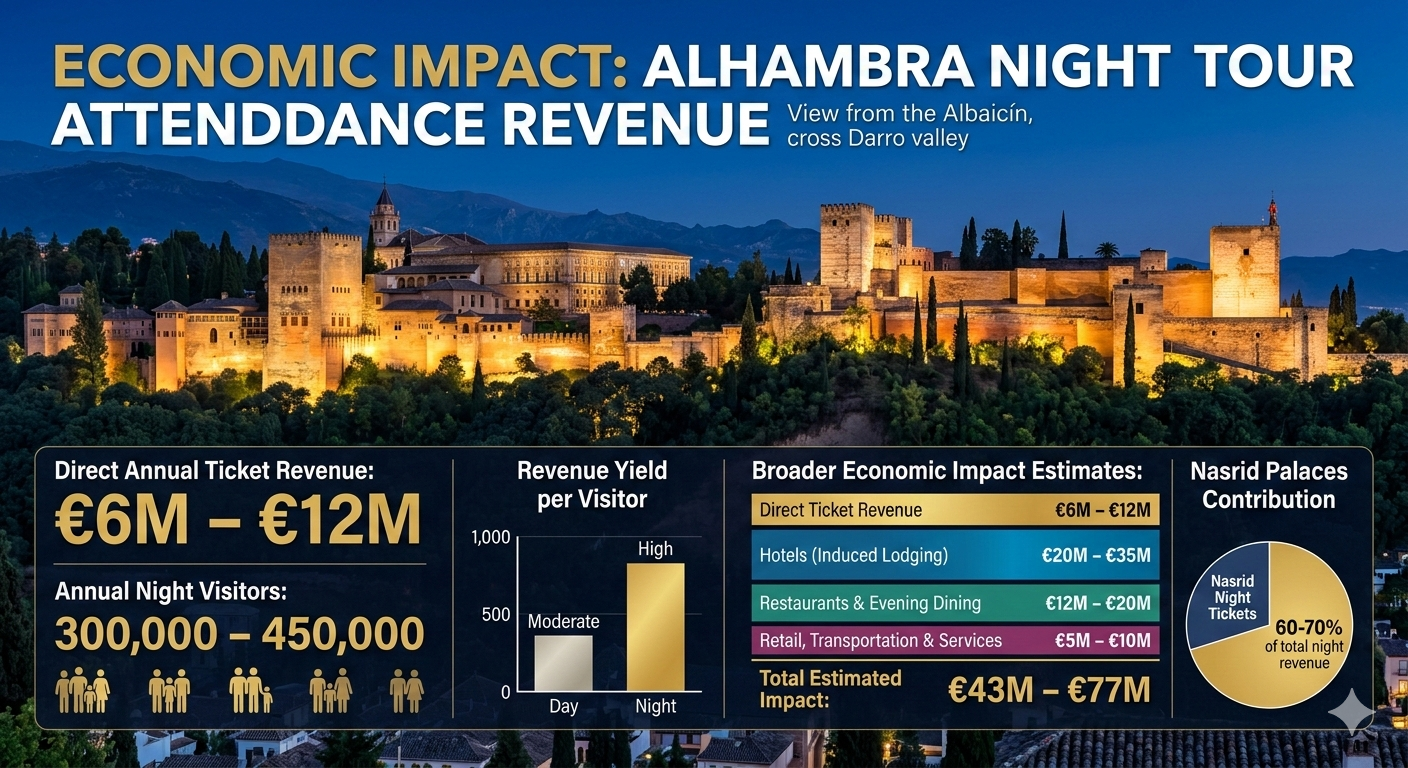
€6 million – €12 million
This excludes secondary spending.
Breakdown: Nasrid Palaces Night Tour Attendance
The Nasrid Palaces are the primary revenue driver of night tourism.
Why Nasrid Night Access Commands Higher Revenue
• Highly limited time slots
• Controlled entry numbers
• High international demand
• Photographic appeal
• Luxury tourism positioning
Estimated Contribution
| Segment | % of Night Revenue |
|---|---|
| Nasrid Night Tickets | 60–70% |
| General Night Entry | 30–40% |
Thus, Nasrid night tours alone may generate €4–8 million annually.
Alhambra Tourism Income: Night vs Day Comparison
Attendance Comparison
| Category | Day Visits | Night Visits |
|---|---|---|
| Annual Visitors | 2.2 – 2.7 million | 300k – 450k |
| Average Ticket | €14 – €18 | €18 – €25 |
| Revenue Yield per Visitor | Moderate | High |
Night tours represent roughly 12–16% of total attendance but a higher revenue percentage.
Revenue Share Estimate
Night tours likely contribute:
15–22% of total ticket revenue
Despite lower volume.
Economic Impact Beyond Ticket Revenue
Alhambra palace night tour attendance revenue extends into Granada’s broader economy.
Hotel Sector Impact
Night tours encourage:
• Two-night stays instead of one
• Late arrivals with overnight booking
• Higher-end accommodation selection
Estimated induced lodging revenue:
€20–€35 million annually linked to night visits
Restaurant and Evening Economy
Night visitors frequently dine before or after tours.
Impact areas:
• Albaicín district restaurants
• Central Granada tapas sector
• Rooftop dining establishments
Estimated restaurant-related revenue:
€12–€20 million annually
Extended Length of Stay
Night tours encourage itinerary restructuring:
Day 1: Day monument visit
Day 2: Night palace visit
This increases:
• Retail spending
• Guided tour purchases
• Transportation services
Conservation Economics: Controlled Capacity Strategy
The Alhambra operates under heritage preservation mandates. Limiting night capacity protects:
• Plasterwork
• Tile mosaics
• Structural humidity balance
• Visitor experience quality
Higher pricing compensates for lower capacity, creating a sustainable revenue-per-square-meter model.
This is a prime example of:
Low volume + high yield = sustainable heritage economics
Tourism Positioning and Brand Value
Night tours enhance the global prestige of the Alhambra.
They position the site as:
• Exclusive
• Experiential
• Luxury cultural tourism
• UNESCO-level premium heritage experience
This elevates Spain’s cultural tourism portfolio internationally.
Data Breakdown Section
Estimated Annual Night Tourism Revenue Impact (Direct + Indirect)
| Category | Estimated Annual Value |
|---|---|
| Direct Ticket Revenue | €6M – €12M |
| Hotels | €20M – €35M |
| Restaurants | €12M – €20M |
| Retail & Services | €5M – €10M |
| Total Estimated Impact | €43M – €77M |
These figures represent modeled economic multipliers.
Policy Implications
For policymakers and tourism boards:
Night tours demonstrate:
• Revenue optimization without increasing volume
• Heritage protection alignment
• Premium tourism development
• Off-peak stabilization strategy
Other heritage sites in Spain and Europe analyze this model for replication.
Comparison with Other Spanish Cultural Attractions
While many Spanish monuments offer extended hours, few command the yield efficiency of the Alhambra night tours.
Key differentiators:
• Architectural lighting design
• Palace interior access
• Strong global brand
• Controlled entry system
Risks and Challenges
Despite strong revenue, night tourism presents risks:
• Over-commercialization perception
• Heritage wear from lighting systems
• Climate adaptation costs
• Visitor management complexity
Balancing exclusivity with accessibility remains essential.
Future Growth Potential
Revenue growth avenues include:
• Tiered premium experiences
• Small-group cultural interpretation
• Seasonal themed night events
• Luxury private access programs
However, growth must remain capacity-sensitive.
FAQs
How much does Alhambra earn from night tours?
Estimated annual ticket revenue ranges between €6 million and €12 million, depending on attendance and pricing mix.
What are Alhambra night visit statistics?
Annual attendance typically ranges from 300,000 to 450,000 visitors, representing around 12–16% of total annual visitors.
Why are night tickets more expensive?
Due to limited capacity, premium positioning, conservation strategy, and exclusive access to areas like the Nasrid Palaces.
Do night tours significantly impact Granada’s economy?
Yes. Combined direct and indirect impact is estimated between €43 million and €77 million annually.
Are Nasrid Palaces night tours the main revenue source?
Yes. They contribute approximately 60–70% of total night tour ticket revenue.
Strategic Analysis for Tourism Researchers
From a tourism economics perspective, Alhambra palace night tour attendance revenue illustrates:
Revenue maximization without massification
Brand premium monetization
Controlled heritage capacity pricing
Cultural asset yield optimization
It stands as a benchmark for sustainable cultural tourism models.
Strong Conclusion
Alhambra Palace night tour attendance revenue is more than a ticketing statistic—it is a sophisticated heritage monetization framework.
With annual direct income reaching up to €12 million and total economic impact potentially exceeding €70 million, night tourism has become an essential pillar of Granada’s cultural economy.
By combining premium pricing, limited capacity, and strategic branding, the Alhambra demonstrates how historic monuments can generate high-value tourism income while preserving architectural integrity.
For tourism analysts, policymakers, and researchers, it remains one of Europe’s most instructive case studies in sustainable cultural revenue management.
