

Introduction
The Amazon logo is more than just a visual symbol. It is a powerful representation of one of the world’s most influential companies. Whether you are a student studying branding, a business owner building a startup, a logo designer analyzing design strategy, or simply someone curious about brand identity, the Amazon logo offers valuable lessons.
When people search for:
- Amazon logo meaning
- History of Amazon logo
- What does the Amazon logo mean
- Amazon smile logo
- Amazon logo evolution
They are looking for more than a graphic explanation. They want to understand the story behind the brand.
In this detailed guide, we will explore:
- The origin and history of the its logo
- The meaning behind the Amazon smile logo
- The design evolution from 1995 to today
- A comparison of old vs new logo versions
- The branding psychology behind the design
- The impact of the its brand logo design on global marketing
Let’s begin with the story behind the name.
The Origin of the Amazon Brand Name
Before understanding the Amazon logo meaning, it is important to understand the brand name itself.
Jeff Bezos founded Amazon in 1994. Originally, the company started as an online bookstore. Bezos wanted a name that:
- Started with the letter “A” (to appear early in alphabetical listings)
- Sounded large and powerful
- Reflected ambition and scale
He chose “Amazon,” inspired by the Amazon River, the largest river in the world by volume. The name symbolized:
- Vast selection
- Global reach
- Immense scale
- Growth and expansion
This idea of vastness and variety would later become central to the Amazon logo design.
Amazon Logo History
The history of the its logo can be divided into clear phases. Each version reflects the company’s growth and changing brand strategy.
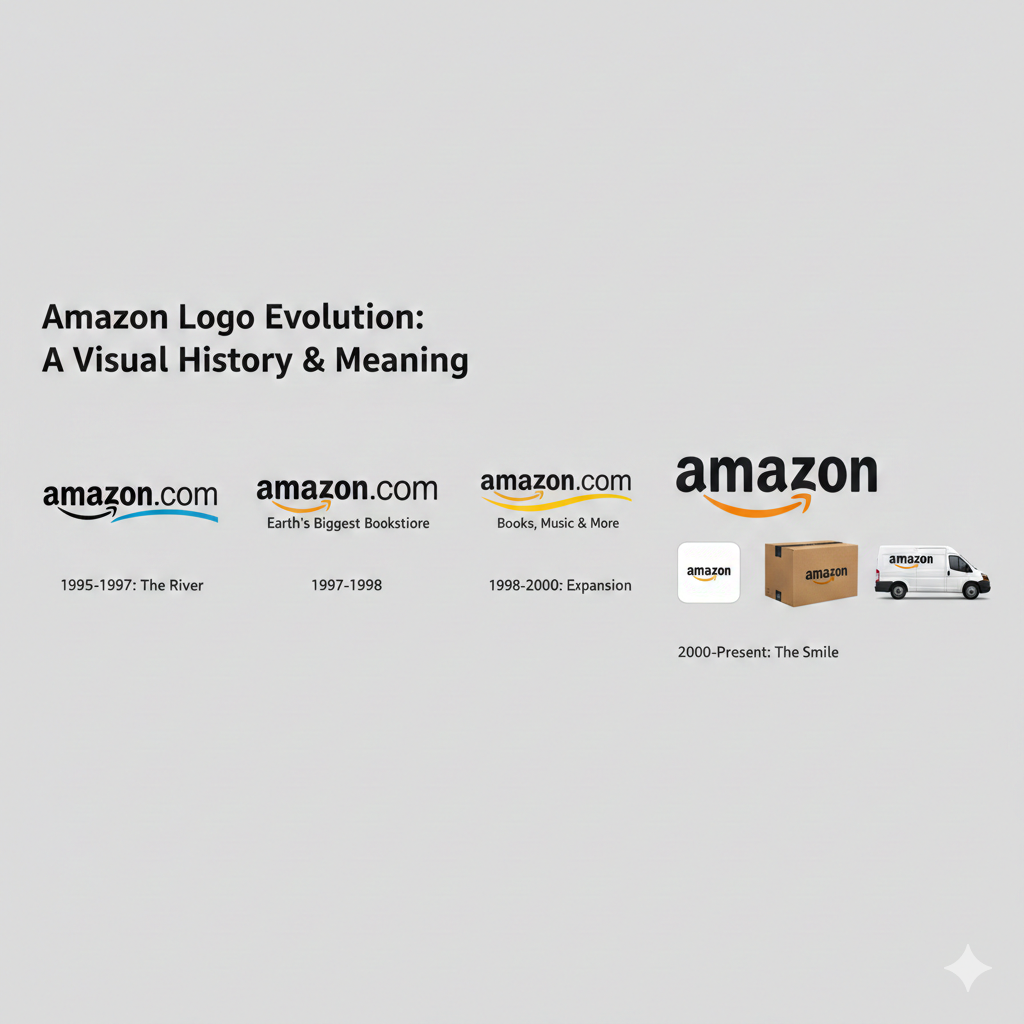
1. The First Amazon Logo (1995–1997)
When it was launched in 1995, its logo was simple and experimental.
Design Features
- Black text reading “amazon.com”
- A blue line underneath
- The letter “O” extended downward, resembling a river
Meaning
The blue underline symbolized the Amazon River. This design visually connected the brand to its name and concept of vastness.
However, the logo looked basic and somewhat unpolished. At this stage, Amazon was still a small startup focused solely on selling books online.
2. The Second Logo Version (1997–1998)
As Amazon grew, it updated its branding.
Design Changes
- Bold black typography
- Tagline added: “Earth’s Biggest Bookstore”
- Cleaner and stronger font
Meaning
This version reflected confidence. Amazon wanted to establish authority in online book retail. The tagline reinforced market dominance.
3. Expansion Logo Phase (1998–2000)
During this period, Amazon expanded beyond books into music, videos, electronics, and more.
Design Elements
- Black lowercase letters
- Yellow underline
- Tagline changed to: “Books, Music & More”
Significance
This phase marked a turning point. Amazon was no longer just a bookstore. The logo began to hint at variety and expansion.
But the real transformation came in 2000.
The Birth of the Amazon Smile Logo (2000–Present)
In 2000, it introduced the logo that would define its global identity.
This is the modern its smile logo.
Key Design Features
- Lowercase black wordmark: “amazon”
- Curved orange arrow below the text
- Arrow connecting the letter “a” to the letter “z”
This design has remained largely unchanged for over two decades, proving its effectiveness and longevity.
Amazon Logo Meaning Explained
Many people ask: What does the Amazon logo mean?
The answer lies in its simple yet powerful symbolism.
1. The Smile
The curved orange arrow resembles a smile.
This represents:
- Customer satisfaction
- Positive shopping experience
- Happiness after receiving a package
Amazon’s entire business model revolves around customer obsession. The smile visually reinforces this philosophy.
2. A to Z Concept
The arrow starts at the letter “a” and ends at the letter “z.”
This symbolizes:
- Everything from A to Z
- Massive product variety
- One-stop shopping platform
It communicates abundance and completeness.
3. The Arrow
The arrow shape also represents:
- Speed
- Delivery
- Forward movement
- Growth
It subtly suggests logistics, shipping, and efficiency.
4. The Orange Color
The orange color conveys:
- Energy
- Warmth
- Optimism
- Affordability
Combined with black typography (which suggests authority and professionalism), the logo balances trust and friendliness.
Amazon Logo Evolution: Old vs New Comparison
Below is a clear comparison of the logo evolution.
| Feature | Old Amazon Logo (1995–1999) | New Amazon Logo (2000–Present) |
|---|---|---|
| Typography | Basic serif / bold text | Clean, lowercase sans-serif |
| Symbol | River underline | Smile-shaped arrow |
| Tagline | Earth’s Biggest Bookstore | No tagline needed |
| Focus | Books | Everything from A to Z |
| Emotional Appeal | Functional | Emotional + Strategic |
| Brand Personality | Startup retailer | Global tech giant |
The shift from descriptive taglines to symbolic design shows brand maturity.
Why the Amazon Brand Logo Design Works
Its brand logo design is considered one of the most effective modern logos. Here’s why.
1. Simplicity
The design is minimal. No complex graphics. No unnecessary detail.
Simple logos are:
- Easier to remember
- Easier to reproduce
- Scalable across platforms
2. Hidden Meaning
Great logos often contain hidden messages. The A-to-Z arrow is subtle but powerful.
It rewards attention and creates brand storytelling.
3. Emotional Connection
The smile builds emotional resonance. It makes the brand feel human.
4. Versatility
The logo works on:
- Websites
- Mobile apps
- Packaging boxes
- Delivery vans
- TV advertisements
Few logos adapt so effortlessly across mediums.
5. Timeless Design
Since 2000, the core logo has not changed significantly. That stability builds brand recognition.
Psychological Impact of the Amazon Smile Logo
Brand logos influence perception subconsciously.
Its smile logo creates psychological triggers such as:
- Trust
- Satisfaction
- Reliability
- Completion
The arrow implies direction and movement. Customers associate it with fast delivery and efficiency.
Over time, the smile became symbolic of receiving a package at the doorstep. It is not just a logo. It is an experience marker.
How the Amazon Logo Reflects Business Strategy
Amazon’s business strategy includes:
- Customer obsession
- Massive product selection
- Fast logistics
- Global expansion
The logo visually communicates all of these principles.
Step-by-Step Breakdown
- Name reflects scale (Amazon River)
- A-to-Z arrow reflects selection
- Smile reflects satisfaction
- Arrow shape reflects delivery
- Clean typography reflects technology focus
This alignment between design and strategy is what makes the logo powerful.
Lessons for Branding Learners and Designers
If you are a branding student or logo designer, here are key takeaways from its logo evolution.
1. Logos Should Evolve with Business Growth
Amazon’s early logo focused on books. As the business expanded, the logo adapted.
2. Hidden Meaning Increases Depth
The A-to-Z detail adds storytelling value without clutter.
3. Simplicity Wins Long-Term
Complex logos often age poorly. The Amazon logo remains modern even decades later.
4. Emotional Branding Is Essential
The smile builds a human connection.
Common Misconceptions About the Amazon Logo
Misconception 1: The Arrow Only Represents a Smile
While it looks like a smile, it also represents A-to-Z variety and forward motion.
Misconception 2: The Logo Has Not Changed
It has evolved multiple times before reaching the current design.
Misconception 3: The Design Is Random
Every element has strategic meaning aligned with business goals.
FAQs
What does the Amazon logo mean?
The Amazon logo represents customer satisfaction (smile), product variety from A to Z, speed, and forward growth.
When was the its smile logo introduced?
The Amazon smile logo was introduced in 2000.
Why does the arrow go from A to Z?
It symbolizes that Amazon sells everything from A to Z.
Has the logo changed over time?
Yes. The logo history includes multiple redesigns from 1995 to 2000 before settling on the current design.
Who designed the Amazon logo?
The 2000 version was created by a design agency working with Amazon to reflect its expanding global identity.
Why is the logo in lowercase?
Lowercase typography makes the brand appear friendly, approachable, and modern.
What color is the Amazon smile?
The smile arrow is orange, symbolizing warmth, energy, and optimism.
The Global Brand Impact of the Amazon Logo
The logo is now one of the most recognized brand symbols worldwide.
Its impact includes:
- Instant brand recognition
- Strong emotional association
- Packaging identity (Amazon boxes with smile)
- Digital icon consistency
- Trust reinforcement
The smile logo appears on millions of packages daily. Over time, it has become associated with anticipation and delivery excitement.
Few logos achieve this level of everyday exposure.
Amazon Logo in the Digital Era
In the era of apps and mobile commerce, logo adaptability matters.
The logo works well as:
- App icon
- Website header
- Social media branding
- Voice assistant interface branding
The simplicity ensures clarity even at small sizes.
Final Analysis: Why the Amazon Logo Is a Branding Masterclass
The logo meaning goes far beyond a simple graphic.
It represents:
- Scale
- Variety
- Customer satisfaction
- Speed
- Growth
- Trust
The history of the logo shows how a brand evolves visually as it grows strategically. From a small bookstore identity to a global technology giant, the logo evolved in alignment with business expansion.
For students, marketers, designers, and entrepreneurs, the logo evolution teaches a critical lesson:
Great logos are not just designed. They are strategically built to reflect vision, mission, and long-term ambition.
The Amazon smile logo proves that:
- Simplicity creates memorability
- Meaning builds connection
- Consistency builds power
After more than two decades, the design remains modern, relevant, and globally trusted.
That is the true power of effective brand logo design.
Conclusion
The Amazon logo is far more than a simple wordmark with a curved arrow. It is a carefully crafted branding asset that reflects the company’s mission, growth, and customer-first philosophy.
From its early days as an online bookstore in 1995 to becoming one of the world’s most powerful technology and e-commerce companies, the history of the logo mirrors the evolution of the business itself. Each redesign marked a strategic shift — from focusing on books to embracing the promise of offering everything from A to Z.

