

Many English learners search for the word “chalant” and wonder if it is real. You may have seen it online, heard it in conversation, or confused it with “nonchalant.” This article explains the chalant meaning in very simple English. We will also answer common questions like:
- What does chalant mean?
- Is chalant a real word?
- What is the chalant definition?
- What is the difference between chalant vs nonchalant?
If you are a student, English learner, or just curious about words, this guide will help you understand everything clearly.
What Does it Mean?
Simple Explanation of Chalant Meaning
The word “chalant” is often used to describe someone who shows interest, care, or concern about something.
If a person is chalant, they:
- Pay attention
- Show interest
- Care about what is happening
- React emotionally
For example:
- She was very chalant about her exam results.
- He sounded chalant when talking about his new job.
However, there is something important you must know.
Is it a Real Word?
Short Answer
No, “chalant” is not officially recognized as a standard English word in most major dictionaries.
You will not find “chalant” listed in traditional English dictionaries like:
- Merriam-Webster
- Oxford English Dictionary
- Cambridge Dictionary
So why do people use it?
Why People Use the Word Chalant
The word became popular because of the word “nonchalant.”
Many people think:
Nonchalant = not caring
So chalant = caring
This makes logical sense. But English does not always work logically.
“Nonchalant” exists. “Chalant” does not officially exist in standard English.
Still, in modern internet language, social media, and casual speech, some people use “chalant” as a playful or informal word.
So when people search for its meaning, they are usually trying to understand:
- The opposite of nonchalant
- Whether it is correct
- If it is proper English
Chalant Definition in Simple Terms
Informal Definition
Chalant (informal): showing interest, concern, or emotional involvement.
Remember:
- It is not a formal dictionary word.
- It is mostly used online or jokingly.
Example sentences:
- Don’t act so chalant. Relax.
- She was very chalant about her birthday party plans.
These sentences are understandable, but they are informal and not considered correct in academic writing.
Understanding Nonchalant First
To fully understand its word meaning, we must first understand “nonchalant.”
Nonchalant Meaning
Nonchalant means:
- Calm and relaxed
- Not showing worry
- Not showing strong emotion
- Appearing not to care
Example sentences:
- He was nonchalant during the interview.
- She gave a nonchalant smile.
The word “nonchalant” comes from French. It originally meant “not caring.”
Because of this, many English speakers assumed there must be a word “chalant.” But historically, that never became a standard English word.
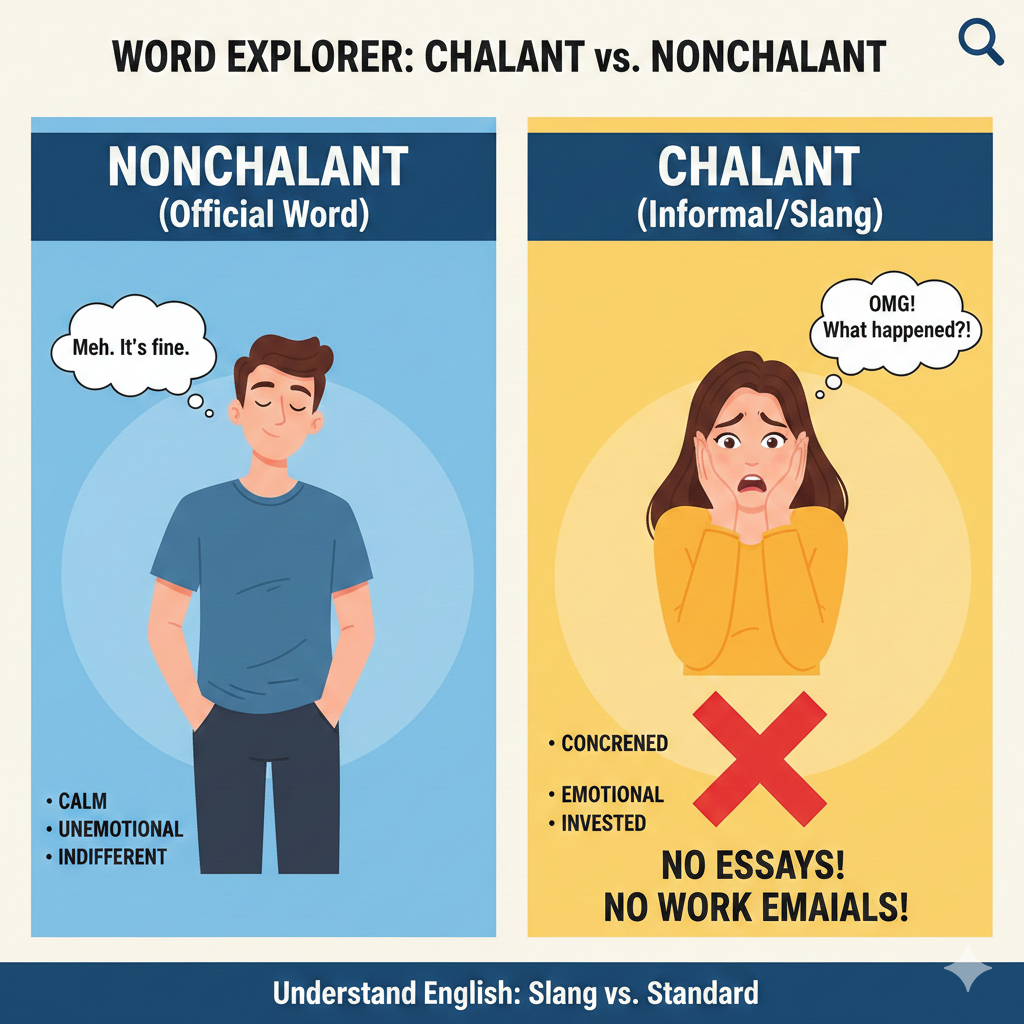
Chalant vs Nonchalant
Difference in Meaning
Chalant (informal):
- Shows care
- Shows interest
- Emotionally involved
Nonchalant (real word):
- Appears calm
- Does not show concern
- Emotionally neutral
Example Comparison
Situation: A student receives exam results.
Nonchalant reaction:
- “Oh, okay. That’s fine.”
- Calm voice, no strong emotion.
Chalant reaction:
- “Really? What did I get? I was so nervous!”
- Shows excitement or worry.
Important Reminder
Only “nonchalant” is officially correct in formal English.
“Chalant” is considered slang or playful language.
If you are writing:
- Essays
- Exams
- Academic papers
- Professional emails
Do not use “chalant.”
Origin of the Word Chalant
Where Did Nonchalant Come From?
The word “nonchalant” comes from French.
In French:
- “Non” means “not”
- “Chaloir” was an old verb meaning “to care”
So “nonchalant” originally meant “not caring.”
English borrowed the word “nonchalant” from French in the 1700s.
Why it Was Never Official
The base word “chalant” was not borrowed into English. Only “nonchalant” was.
Over time, English speakers assumed:
If nonchalant exists, it must also exist.
But that is not how borrowing works. English sometimes borrows only one form of a word.
So “chalant” became a back-formation. That means people created it later by removing “non” from “nonchalant.”
Back-formations sometimes become real words. But so far, “chalant” has not been officially accepted.
Why Is Chalant So Popular Online?
Social Media Influence
On platforms like:
- TikTok
People enjoy playing with language.
“Chalant” sounds funny and logical. It feels like a “missing word.”
Example online use:
- “Stop being so chalant about it.”
- “I’m trying to stay nonchalant, but I’m actually very chalant.”
These sentences are humorous and relatable.
Internet Slang Evolution
Language changes over time. Some slang words eventually enter dictionaries.
For example:
- Selfie
- Emoji
- Blog
But not all slang becomes official. It depends on:
- Frequency of use
- Acceptance by formal writing
- Recognition by language experts
Right now, “chalant” is still informal.
When Should You Use it?
Situations Where It Is Okay
You may use “chalant” in:
- Casual conversation with friends
- Social media posts
- Creative writing
- Humor
Example:
- “I was trying to be cool and nonchalant, but I was actually very chalant.”
Situations Where You Should Avoid It
Do not use “chalant” in:
- School essays
- Business emails
- Academic research
- Job applications
- Professional communication
In these situations, use clear and correct words like:
- Concerned
- Interested
- Emotional
- Excited
- Nervous
Better Alternatives to Chalant
Since “chalant” is not officially correct, here are better words you can use instead.
Words That Mean “Showing Interest”
- Concerned
- Engaged
- Attentive
- Interested
- Involved
- Emotional
- Responsive
Example:
Instead of:
- She was very chalant about the meeting.
Say:
- She was very concerned about the meeting.
- She was deeply involved in the meeting.
These sound more natural and professional.
Common Mistakes About Chalant Meaning
Mistake 1: Thinking it Is in the Dictionary
Many people believe “chalant” must be a real word because:
- It sounds correct.
- It is the opposite of nonchalant.
But English does not always create opposites by removing prefixes.
For example:
- Inflammable does not mean “not flammable.”
- Ruthless exists, but “ruth” is rarely used.
English is full of exceptions.
Mistake 2: Using it in Formal Writing
Even if many people use “chalant” online, it is not accepted in formal English.
If you are learning English for exams like:
- IELTS
- TOEFL
- School tests
Do not use “chalant.”
It may be marked as incorrect.
Chalant Word Meaning in Daily Conversation
Even though it is informal, understanding its meaning helps you understand modern English.
If someone says:
- “Why are you so chalant about this?”
They probably mean:
- Why do you care so much?
- Why are you reacting strongly?
If someone jokes:
- “I’m trying to be nonchalant but I’m very chalant.”
They mean:
- I’m pretending not to care, but I actually care a lot.
Understanding slang helps you understand real conversations better.
Examples of Chalant in Sentences
Here are simple examples to help English learners.
Example 1
She was very chalant about her wedding plans.
Meaning: She cared a lot about her wedding plans.
Example 2
Don’t be so chalant. It’s not a big problem.
Meaning: Don’t worry or care too much.
Example 3
He acted nonchalant, but inside he was very chalant.
Meaning: He pretended not to care, but he actually cared a lot.
These examples show how people use the word informally.
Why English Learners Get Confused
English learners often look for logical patterns.
Nonchalant exists.
So it should exist.
But English has many irregular patterns because it borrows words from:
- French
- Latin
- Greek
- German
- Spanish
Not all borrowed words follow the same structure.
That is why it meaning causes confusion.
Will Chalant Become a Real Word?
Language experts cannot predict the future perfectly.
Some slang words eventually become accepted. Others disappear.
For “chalant” to become official, it would need:
- Widespread use
- Acceptance in books and journalism
- Recognition by dictionary editors
Right now, it is still considered informal and unofficial.
FAQs
What does chalant mean?
It informally means showing interest, care, or concern. It is often used as the opposite of nonchalant.
Is it a real word?
No, it is not officially recognized in major English dictionaries. It is considered slang or informal language.
What is the chalant definition?
Informally, its means emotionally involved or caring about something. But it is not a standard dictionary word.
What is the difference between chalant vs nonchalant?
Nonchalant is a real word that means calm and not showing concern. It is an informal word people use to mean the opposite: showing concern or interest.
Can I use it in an essay?
No. Avoid using it in formal writing. Use proper words like concerned, interested, or emotional instead.
Why do people think it is real?
Because it sounds like the logical opposite of nonchalant. Many people assume removing “non” creates a real word.
Quick Summary for Beginners
Here is a simple summary:
- Chalant meaning: showing care or interest (informal).
- It is not a real dictionary word.
- It is used mainly online and in casual speech.
- Nonchalant is the correct, official word.
- Do not use it in formal writing.
Understanding this helps you avoid mistakes in English.
Conclusion
The word “chalant” is an interesting example of how language changes and how people try to make English more logical. Even though it makes sense as the opposite of “nonchalant,” it is not officially recognized as a standard English word.
When people search for its meaning, they usually want to know if it is real and how to use it. Now you know:
- It is informal.
- It means showing care or concern.
- It should not be used in academic or professional writing.
- Nonchalant is the correct and official word.
As an English learner or student, it is important to know the difference between slang and standard English. You can understand it when you hear it, but choose proper vocabulary when writing formally.
Language is always evolving. Maybe one day “chalant” will appear in dictionaries. Until then, use it carefully and only in casual situations.
