

What Are Nahttypen?
The word nahttypen is a German term that means types of seams.
In sewing and textile production, a seam is created when two or more pieces of fabric are joined together using stitches.
In simple words, nahttypen erklären, how fabric pieces are connected, how strong the connection is, and how the finished garment looks and behaves when worn or washed.
Understanding nahttypen beim Nähen is essential because:
- Different fabrics need different seams
- Clothing durability depends on the correct seam choice
- Seam type affects comfort, stretch, and appearance
- Professional finishing requires proper nahtarten textil knowledge
Why Are Nahttypen Important in Sewing?
Structural Importance
Seams hold the entire garment together. Even expensive fabric becomes useless if the seam fails. Choosing the correct it for clothing ensures long-lasting wear.
Visual Appearance
Some seams are visible on the outside of clothing. Decorative nahttypen are often used to enhance design and style.
Comfort and Fit
Incorrect seams can cause skin irritation, stiffness, or poor drape. Proper nahttypen nähnen techniques improve comfort.
Fabric Compatibility
Lightweight, stretch, denim, leather, and knit fabrics all require different nahtarten textil approaches.
Basic Classification of Nahttypen
Before learning individual seam types, it is important to understand how seams are generally classified.
Main Categories of Nahttypen
1. Plain Seams
Simple seams used in most garments
2. Enclosed Seams
Seams that hide raw edges inside
3. Decorative Seams
Visible seams used for style
4. Functional Seams
Used for strength, stretch, or reinforcement
5. Specialized Textile Seams
Industrial or advanced seams for specific materials
Plain Seams (Grundlegende Nahttypen)
What Is a Plain Seam?
A plain seam is the most basic and commonly used it in sewing. It joins two pieces of fabric with right sides facing each other.
Where Plain Seams Are Used
- Shirts
- Dresses
- Skirts
- Trousers
- Home textiles
Step-by-Step: How to Sew a Plain Seam
- Place fabric pieces right sides together
- Align edges evenly
- Stitch along the seam line
- Press the seam open or to one side
Advantages
- Easy to sew
- Suitable for beginners
- Works with most fabrics
Disadvantages
- Raw edges may fray
- Needs finishing (zigzag or overlock)
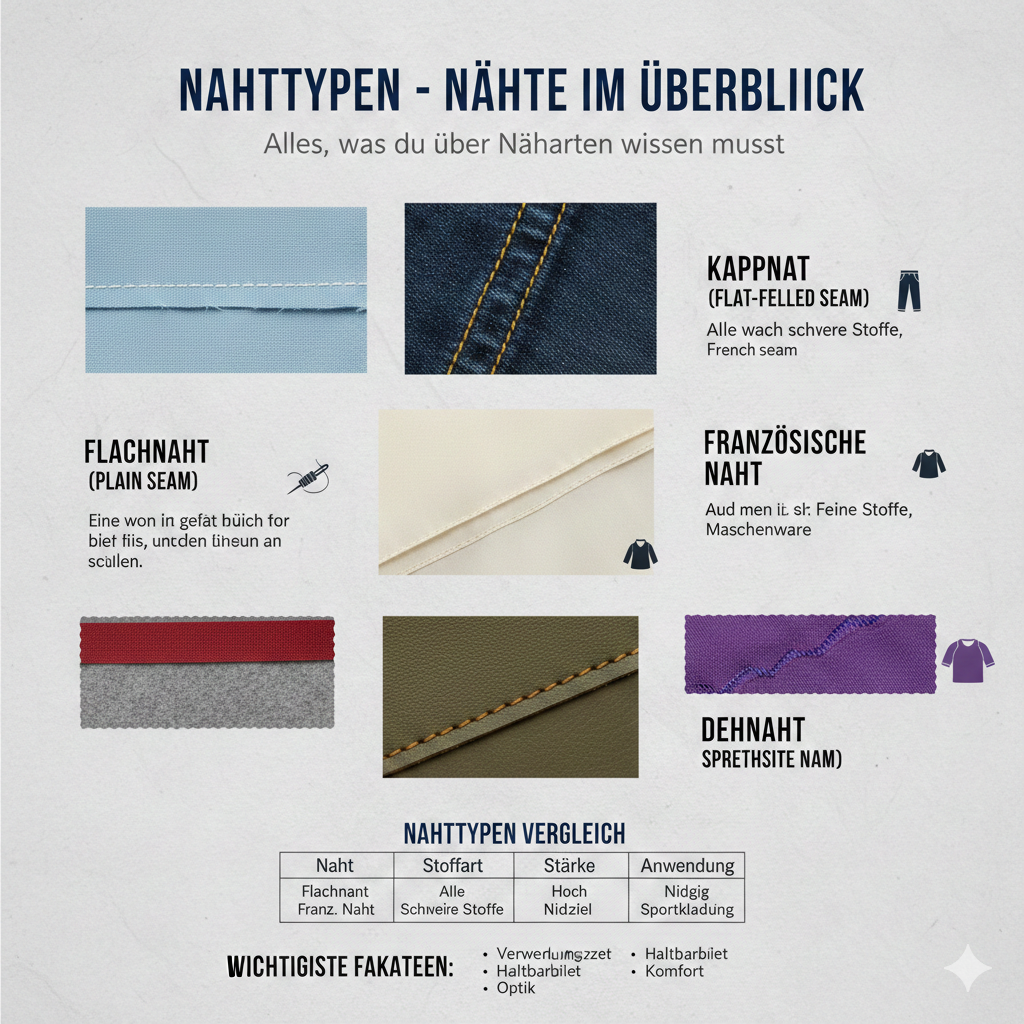
French Seam (Französische Naht)
Nahttypen Erklärung: French Seam
A French seam is an enclosed seam that hides raw edges completely. It is commonly used for lightweight and transparent fabrics.
Typical Applications
- Chiffon blouses
- Silk garments
- Baby clothing
- Lingerie
How a French Seam Is Sewn
- Place fabric wrong sides together
- Sew a narrow seam
- Trim seam allowance
- Turn fabric right sides together
- Sew again to enclose edges
Benefits
- Clean finish
- No raw edges visible
- Professional look
Limitations
- Not suitable for thick fabrics
- Requires precision
Flat-Felled Seam (Kappnaht)
What Is a Flat-Felled Seam?
A flat-felled seam is a very strong seam where seam allowances are folded and stitched flat.
Common Uses in Clothing
- Jeans
- Workwear
- Shirts
- Jackets
Why This Nahttypen Is Popular
- Extremely durable
- Withstands frequent washing
- Neat inside and outside
Step-by-Step Process
- Sew a plain seam
- Trim one seam allowance
- Fold the wider allowance over the trimmed one
- Stitch down flat
Lapped Seam (Überlappte Naht)
Explanation
A lapped seam overlaps one piece of fabric over another instead of placing edges together.
Applications
- Leather garments
- Vinyl materials
- Upholstery
- Heavy textiles
Key Advantages
- Strong seam
- No bulky seam allowance
- Ideal for thick materials
Bound Seam (Eingefasste Naht)
What Is a Bound Seam?
In this nahttypen, raw edges are enclosed using binding tape or bias tape.
Where It Is Used
- Jackets
- Coats
- Unlined garments
Benefits
- Decorative finish
- Prevents fraying
- Adds strength
Decorative Nahttypen
Purpose of Decorative Seams
Decorative seams are used for visual appeal while still providing structural support.
Common Decorative Nahtarten Textil
- Topstitched seams
- Piped seams
- Tucked seams
Clothing Examples
- Fashion dresses
- Designer jackets
- Traditional garments
Stretch Seams (Nahttypen für dehnbare Stoffe)
Why Stretch Seams Are Important
Stretch fabrics require seams that move with the fabric.
Common Stretch Nahttypen
- Zigzag seam
- Stretch straight stitch
- Overlock seam
Applications
- Activewear
- Sportswear
- Knit garments
Comparison Table: Verschiedene Nahttypen
| Nahttypen | Strength | Fabric Type | Difficulty | Common Use |
|---|---|---|---|---|
| Plain Seam | Medium | All fabrics | Easy | Everyday clothing |
| French Seam | Low-Medium | Lightweight | Medium | Delicate garments |
| Flat-Felled | High | Heavy | Medium | Jeans, shirts |
| Lapped Seam | High | Thick materials | Medium | Leather |
| Bound Seam | Medium | Medium weight | Medium | Jackets |
| Stretch Seam | Flexible | Knit fabrics | Easy | Sportswear |
Choosing the Right Nahttypen beim Nähen
Factors to Consider
- Fabric weight
- Fabric stretch
- Garment purpose
- Washing frequency
- Skill level
Beginner Recommendation
Beginners should start with:
- Plain seams
- Zigzag finished seams
- Basic stretch seams
Common Mistakes with it
Using Wrong Seam for Fabric
Heavy seams on light fabric cause distortion.
Ignoring Seam Finish
Unfinished seams lead to fraying.
Incorrect Seam Allowance
Too narrow seams weaken garments.
FAQs
What are Nahttypen?
Nahttypen are different types of seams used to join pieces of fabric in sewing and textile production.
Which Nahttypen are suitable for beginners?
Plain seams, zigzag seams, and basic stretch seams are the most suitable options for beginners.
Which Nahttypen are used in clothing?
Plain seams, French seams, flat-felled seams, and stretch seams are commonly used in garment construction.
Why are there different Nahttypen?
Different fabrics and garment purposes require varying levels of seam strength, flexibility, and appearance.
Are Nahttypen important for professional clothing?
Yes, choosing the correct nahttypen ensures durability, comfort, and a professional finish.
Conclusion
They are the foundation of sewing and garment construction. Understanding verschiedene Nahttypen allows beginners and professionals alike to choose the correct seam for every project. From basic plain seams to advanced textile seam techniques, each has a specific purpose, strength level, and application.
For anyone learning sewing, tailoring, or fashion design, mastering it beim Nähen is not optional—it is essential. With the right knowledge, even simple garments can look professional, last longer, and feel more comfortable.
